All of us, of course, have heard of the vocations to marriage and religious life, but have you ever heard of consecrated virginity?
Pre-dating religious life by several centuries, consecrated virginity is the oldest recognized form of consecrated life in the Catholic Church. St. Agnes, St. Lucy, and St. Cecilia—to name a few—all lived as consecrated virgins in the early church.
Consecrated virgins are women who “are consecrated to God by the diocesan bishop according to the approved liturgical rite, are mystically betrothed to Christ, the Son of God, and are dedicated to the service of the Church.” (Canon Law 604)
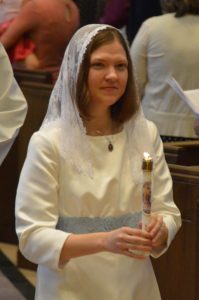
I had the privilege of attending a Mass of Consecration for Leandra Hubka, a woman in our diocese whom Jesus called to become His bride. The Mass, which was like a mix between a wedding and an ordination, was one of the most beautiful liturgies I have ever attended. Leandra’s story not only sheds light on this beautiful, little-known vocation, but also on the importance of sincerely discerning the unique call Christ has for each of us, rather than just settling for the “status-quo.”
Leandra always thought she would get married. This was mostly because it was the only vocation she knew while growing up.
Throughout her time in college, Leandra grew in her knowledge and practice of authentic Catholic community—developing a life of prayer, pursuit of holiness, and Catholic worldview. The question of her vocation began to arise after college, and around that time, a friend shared with Leandra a blog site of a consecrated virgin. Having never before heard of the vocation, Leandra “brushed it off”...but a tiny seed was planted in her heart. Months later, while in prayer, Leandra was given a strong sense that she was in fact being called to a life consecrated virginity.
Leandra had already planned to attend graduate school, so she decided that if the call was authentic, it would stick around. In the meantime, she was advised to discern the “other” vocations of marriage and religious life. This lead to a growing confirmation that Leandra only felt peace with a life of solitude.
Marriage is definitely not known for its “solitude,” and religious life, even to the degree of a cloistered or hermit community, still had too much of a communal aspect to suit Leandra’s needs. After completing her graduate degree, Leandra settled close to home, and by the end of Christmas that year, her call to consecrated virginity became “crystal clear.”
A unique aspect of consecrated virginity is that the woman must be consecrated by a diocesan bishop and live and work in service to the diocese.
This can take on many forms, depending on the individual gifts of the person, offering a unique alternative to apostolate-specific religious communities. Leandra relocated to the home city of her diocese, without a job, in hopes of pursuing the next steps to her vocational call.
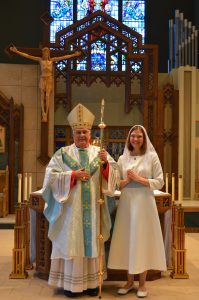
Image courtesy of the Diocese of Winona-Rochester.