
If God is infinitely good and infinitely powerful, why is there evil in the world?
Such is one of the central questions of the human race, the question pondered in the Book of Job and bandied back and forth among pious and impious men throughout the centuries. St. Thomas held it to be one of the two great objections to the existence of God.
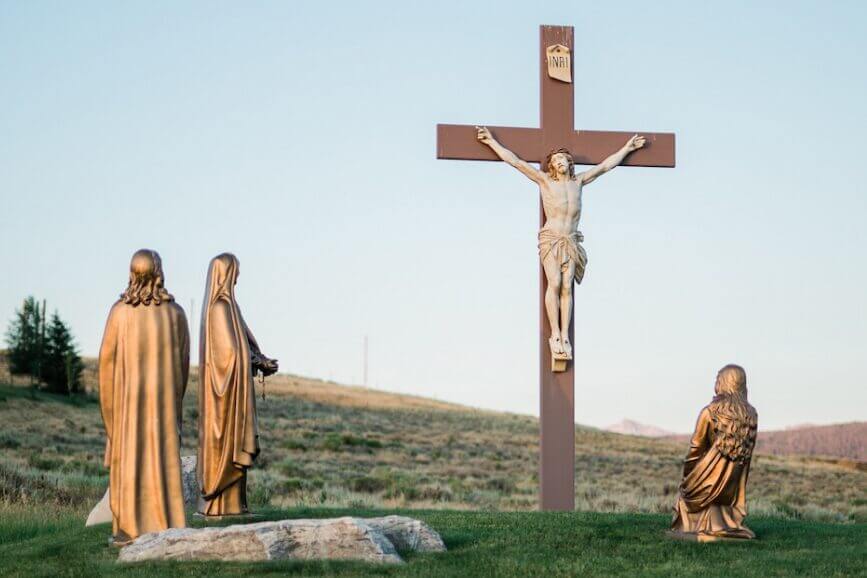
Christ Himself, hanging upon the Cross in the very apex of His agony, asked the question in the words of Psalm 22: “O God, my God, why hast thou forsaken me?”
The answer came on Easter morning.
This is the pattern of God’s response to evil, and indeed the pattern of the world that we know. A thing is created good. Then it is wrecked by sin, resulting in darkness, dissolution, and despair. We have a period where all seems lost and the forces of darkness are gloating in their triumph.
But then comes the change: the turn that does not reverse the horror of before, but transforms it. In a thoroughly unexpected manner, what had seemed the end turns out to be the beginning of something totally new. Something that would not have been but for the evil. As said in 1 Cor. 15:42-43 “It is sown in corruption, it shall rise in incorruption. It is sown in dishonour, it shall rise in glory”.
Let’s back up a bit.
All things exist to glorify their Creator, each in its own proper way. The infinitude of God is shown in the great variety of His creatures, each embodying some idea in His mind in its unique nature. A rabbit glorifies God insofar as it is a rabbit: as it embodies ‘rabbit-ness’.
A good that rises in response to evil must be different from a good that comes purely from goodness. Not better, certainly, but different. And thus, the good that triumphs evil glorifies God in a way no other goodness does.
This is why God permits evil: because evil creates the opportunity for the corresponding good to manifest in ways it would otherwise not have, thus creating a specific, unique kind of goodness.
The Crucifixion and Resurrection of Christ is this pattern in miniature, focused laser-like to an intense point. The greatest possible sin—the murder of God—becomes the greatest good—the conquest of sin and the opening of paradise.
For this reason, we say “Oh, happy fault!”
For it was the evil of our first parents’ rebellion that brought us the supreme good of Christ’s resurrection. Not only that (if anything can add to that), it brought about the unique, the specific kind of glory and goodness that we experience throughout history and every day in our own lives: that of self-sacrifice, courage, devotion in the face of adversity, and faithfulness in the face of temptation.
Had we not fallen, the world would, of course, have been very happy. Happy to a degree and in a manner we can scarcely imagine. But no heroism. No chivalry. No martyrdoms. No acts of mercy. No heroic endeavors of fidelity. No defying the odds for righteousness’s sake. None of those particular glories that come from resisting or responding to evil. In fact, none of the things that we tend to like best about our own story.
It is not that it would have been worse if we had never fallen, it’s that it would not have been the same.
In Christ’s death and resurrection is the secret of our whole world: it is the unique nature that happens when good is drawn out of evil.
This is something to keep in mind, to meditate upon when we’re struggling and when all seems to be horrible and we wonder why God isn’t helping us. Whether it's from looking at what’s in the news or what isn’t in our inbox, whether it's fear of disasters in the world or perpetual loneliness in life, we often feel that there is no hope.
Needless to say, this is especially important at the moment, as the world seems to be imploding around us and the innumerable chickens we’ve been tossing into the wind for the past century or so are swarming home to roost. We live in frightening times, when things are almost certain to get worse before they get better, and many of us are wondering just where it will all end. Perhaps we even wonder if God is really there, or if He cares about us at all.
Know that God is working through these trials to bring something into being, something glorious that would not otherwise have been, even if it is ‘only’ the fact of your enduring it. He has a particular idea for you. He means to fit you for a particular place in His Heavenly court. To do that, you must pass through this struggle. Because it is the struggle, and your reaction to it, that will make you the kind of being He wants you to be.
To dial things down a little, our relationships are as unique as our personalities.
Part of that uniqueness comes from what happened before: from the mistakes made, from the long periods of waiting, from the lonely nights, and the times when it felt hopeless. Even if you haven’t met your future spouse, you are even now forging your relationship by this period of waiting, of looking, and of disappointment.
Persevere, and one day—either in this world or the next—you will find yourself crying “Oh, happy fault that has led me to this!”