
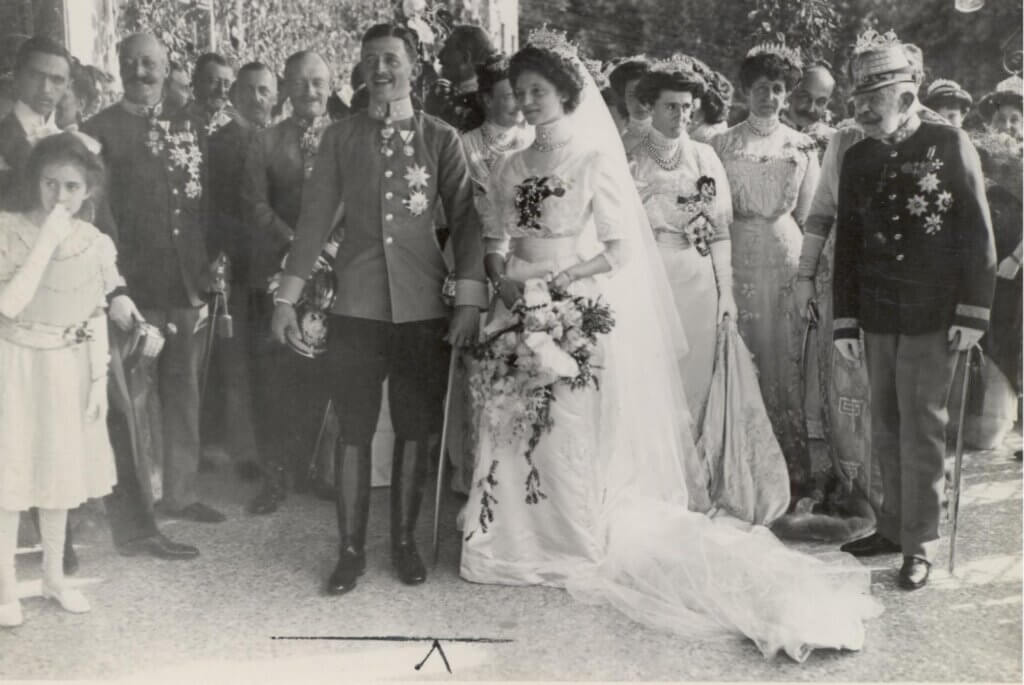
In the marriage of Blessed Karl of Austria and Servant of God Zita of Bourbon-Parma, the Church holds up for us a model relationship. Karl and Zita certainly faced the battering of the world’s breakers and tides, but the rock of their marriage held firm through all of it: political turmoil, war, loss, exile, and the everyday challenges of raising a large family.
Blessed Karl (or Charles) was born in 1887, and through a series of tragedies, found himself assuming the role of Emperor of Austria and King of Hungary during the conflagrations of World War I, making him the last Catholic monarch of Europe.
It was a forbidding task: he had to try to carve a path to peace when most of the rest of Europe was bent on war, and he had to try to unite a people who were increasingly divided. Through it all, though, he had at his side his trusty Zita, whom he first met as a child and later courted as a young man.
They fell in love and were married in 1911.
They eventually had eight children together. Their marriage and family life were exemplary, full of love and sanctity, even though it ended tragically too soon when Karl died at the age of just 34.
Even before marriage, Karl and Zita worked hard to make God the center of their relationship and His love the fuel for the flame of their shared affection for one another. They saw marriage as their path to God, and immediately after the wedding, Karl told his bride, “Now we must help each other attain heaven.”
Here are just a few of the ways that Karl and Zita sanctified their relationship–strategies that dating (or even married couples) can use today to deepen their love for one another.
Their Relationship was Founded on the Eucharist and the Blessed Virgin Mary
Blessed Karl fanned the flames of a great love for the Eucharist from an early age, and when he eventually proposed to his beloved Zita, he did so in front of the Blessed Sacrament. There’s a beautiful little book about Karl and Zita’s relationship and how it can help couples today prepare for marriage, entitled Bold Union: Preparing for Marriage with Karl and Zita. In it, we read, “When [Karl and Zita] met, Karl was already a very devout Catholic. He had an intense prayer life–with contemplative prayer and daily adoration before the Blessed Sacrament. As they united their lives, they had this common idea of marriage as a means of sanctification.”
On the couple’s wedding bands, they had inscribed an ancient prayer to the Blessed Virgin: "Sub tuum praesidium confugimus, sancta Dei Genitrix" (We take refuge under your protection, O Holy Mother of God). They also visited the Marian shrine of Mariazell on their honeymoon in order to consecrate their marriage to the Mother of God.
When Karl was fighting as a soldier on the front during WWI, he completely wore out the Rosary he’d been given by St. Pius X as a wedding present.
When a new child was born into the family, Karl would attach a Marian medal to the crib.
They Had a Sense of Fun
We often incorrectly picture saints as drab, dreary, gloomy individuals with no sense of fun. This is completely erroneous, as the saints are always among the happiest people alive and the people who best know how to be cheerful. Zita and Karl were no exception. When they were young, they enjoyed a variety of lively activities, including horseback riding, skating, sledding, hunting, and various family escapades. Karl in particular was known for his good sense of humor and his cheerful attitude. He also loved plants, animals, and the outdoors. All of this healthy activity was eventually shared with the couple’s children, who were raised to enjoy and appreciate the beauty of the world.
Because Their Home Was Holy, It Was Also Happy
Because Karl and Zita had their priorities right and loved one another with a deep love, an immense joy and peace pervaded their home. As the official Emperor Karl website explains, “Karl and Zita had a loving relationship, and were each other's soul mate. They were devoted to each other, supported each other, and had the same Christian values. Their children were brought into this loving environment, and each child was cherished as a gift from God.”
According to a military chaplain whose words are recorded in Bold Union, the couple had a very happy home. The chaplain wrote, “His family life is ideal…every day [when he was away from home] he telephoned, telegraphed, or wrote his wife. A deep love, illuminated by a religious spirit, reigns in this family. His Zita is everything to him.”
Theirs was a home truly centered on Christ, with frequent attendance at Mass, catechetical instruction, First Friday devotions, a special love for Our Lady, and consecration to the Sacred Heart.
Zita recalled, “In this atmosphere of the most warm love, unbreakable trust, honesty without reserve, intimate security and reciprocal respect, our marriage became extraordinarily happy. [Karl] was the most faithful loving, good patient, gentle, and considerate husband.”
Now that’s something worth striving after.